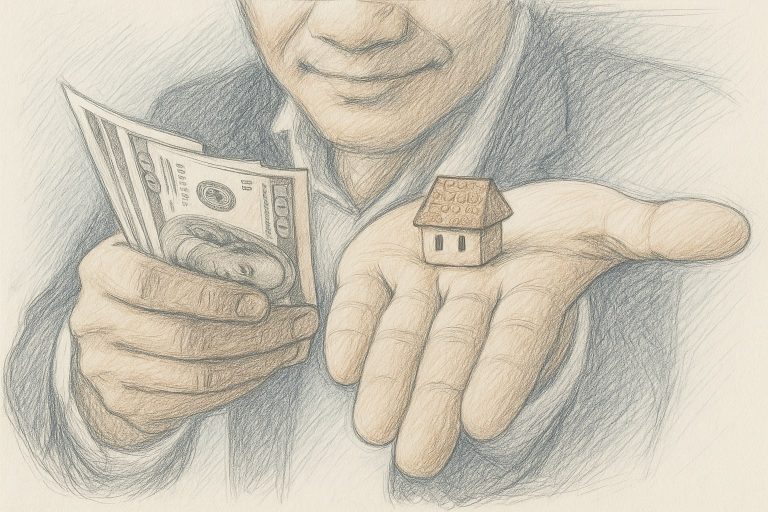

Buying, selling, or leasing real estate is often one of the most important financial decisions we make in life. In this process, terms like earnest money deposit and contract termination penalties play a critical role. But what exactly do they mean, and how do they work in practice? 👇
What Is Earnest Money and Why Is It Important?
In Serbian real estate transactions, “kapara” is a sum of money paid by the buyer to the seller upon signing a preliminary agreement (predugovor). This payment shows the buyer’s serious intention to go through with the purchase and acts as a type of financial guarantee for the seller.
⚖️ Equivalent in English-speaking countries: This concept is similar to the earnest money deposit used in the U.S. and UK. However, in Serbia, it has stronger legal implications than just showing good faith — it can trigger specific financial penalties if the contract falls through.
💰 Typical amount: Usually around 10% of the agreed purchase price, although the amount can vary based on mutual agreement.
💡 Example of earnest money (“kapara”)
If the agreed price of the property is €100,000, the buyer may pay €10,000 as earnest money. This amount will be deducted from the final purchase price if the deal goes through.
Once the final purchase agreement is signed, the earnest money becomes part of the full price, reducing the remaining balance the buyer needs to pay.
What Happens If One Party Backs Out?
Here’s where it gets interesting — earnest money in Serbia is often tied to the concept of contractual penalty (odustanica) in case either party decides not to finalize the agreement.
If the buyer withdraws:
The seller has the right to keep the earnest money.
If the seller withdraws:
The buyer is entitled to receive double the earnest money back.
💡 Example of a cancellation penalty (“odustanica”)
You, as a buyer, pay €5,000 as earnest money. If you back out, the seller keeps that €5,000. But if the seller cancels the deal, they must return €10,000 to you.
📌 Note: This “double refund” rule does not exist in most English-speaking countries, where earnest money is usually just forfeited or refunded depending on contingencies, not doubled.
When Is Earnest Money Refunded?
There are situations in which the earnest money can be fully refunded to the buyer:
- Mutual agreement to terminate the deal: Both parties agree to walk away without further obligations.
- Force majeure: Natural disasters or unforeseen events make it impossible to fulfill the contract.
- Shared fault: If both the buyer and the seller are responsible for the failure of the deal, the earnest money is typically returned to the buyer.
How Does Earnest Money Enhance Transaction Security?
Earnest money serves as a critical tool to ensure trust and seriousness in the real estate process:
✅ For the buyer: It guarantees that the seller won’t walk away easily and offers financial compensation if they do.
✅ For the seller: It shows that the buyer is committed and won’t cancel the deal without consequences.
🔐 Kapara in Serbia serves as both a sign of good faith and a binding contractual mechanism, making real estate transactions more secure.
Practical Tips for Agreements Involving Earnest Money
- Always draft a preliminary agreement: The terms of the deposit must be clearly defined in writing.
- Hire a legal expert: A real estate attorney or licensed agent can help avoid pitfalls.
- Double-check the terms: Ensure all conditions are clear, including the amount of the deposit, refund policies, and scenarios where it is forfeited or doubled.
Why Should You Understand These Concepts?
Understanding earnest money and termination penalties can save you significant money and stress when buying, selling, or leasing property. Without clear rules and awareness of how these mechanisms work, you risk ending up in a financially unfavorable or legally tricky situation.
Final Thoughts: Why Hire a Real Estate Professional?
Real estate transactions involve complex legal and financial elements. That’s why working with a professional — whether a lawyer or a licensed agent — is crucial for a safe and successful experience. Experts help you define the terms of earnest money and cancellation fees clearly, protecting your interests and your money.
💼👉 Don’t take risks — consult a professional and make your next real estate move with confidence!